Artist Cristina Céspedes's intervenes in MEET/Russian Museum Collection for Málaga de Festival 2026
‘Consensus ritualis' offers an immersive experience through the traditional artistic development of an intervention on a wall
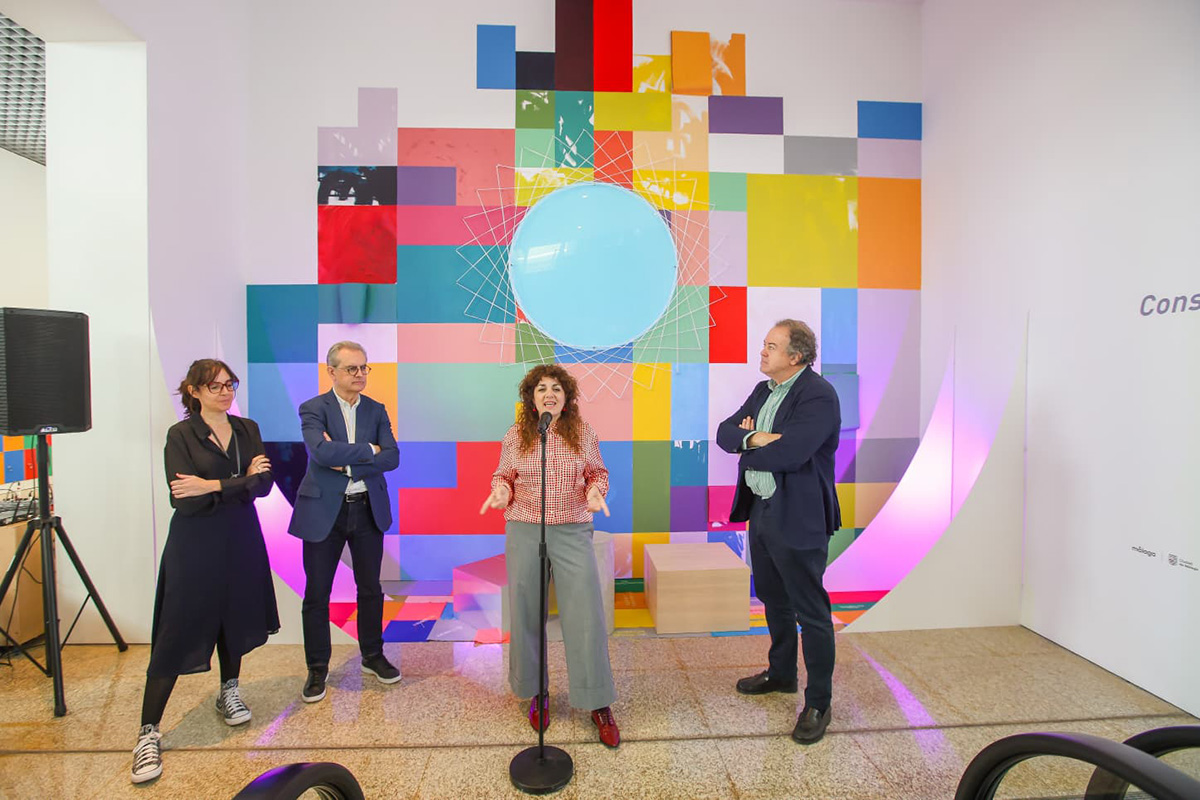
Málaga-born artist Cristina Céspedes has been commissioned to create an intervention on the wall opposite the staircase leading to the MEET/Russian Museum Collection exhibition for the Málaga de Festival 2026 programme. The inauguration of this intervention took place today with the artist in attendance, along with Luis Lafuente, Director of the Public Agency for the Management of Pablo Picasso's Birthplace and other museum and cultural facilities, and Juan Antonio Vigar, Director of the Festival de Málaga.
‘Consensus ritualis', by Cristina Céspedes is an immersive installation that reinterprets the interior of the European Council building through an artistic dialogue between spaces designed for the management of the commons and for culture and artistic practice. Conceived using the colour palette of the artist Georges Meurant, the work transports a real space for decision-making to a sensitive territory, where design is transformed into an artistic and symbolic experience.
The artist draws inspiration from the political heart of Europe and proposes a reflection on consensus as a fragile and profoundly human gesture that must be placed at the centre of spaces and ways of inhabiting them, in everyday life. The table, the central element of the work, acts as a ritual device and as a surface where words are placed, circulate, and are transformed. The space is configured as a place of encounter and silent tension, where dialogue, negotiation, and listening are revealed as complex and imperfect processes.
The visitor is invited to occupy the empty space, to sit and participate in a collective gesture that appeals to the need for a convergence of perspectives, since the small size of the table brings bodies closer, accelerates the flow of words, and generates direct involvement, underscoring the urgency of exchange and shared responsibility.
In 'Consensus ritualis', the space is activated as a place for dialogue, debate, community, and conflict management, evoking the essence of European politics: arguing, debating, and negotiating with goodwill. A necessarily imperfect politics, in which collaborative work becomes indispensable for sustaining the complexity of the common good and for imagining, through encounter, another possible Europe..
Cristina Céspedes
A visual artist, she holds a degree in Fine Arts from the University of Granada, a Higher Degree in Construction and Decoration Project Management from the San Telmo School of Art (Málaga), a Master's degree in Social Developments of Artistic Culture from the University of Málaga (in its inaugural graduating class), and a Master's degree in Interior Design from the University of Barcelona. She was awarded the University of Málaga and Unicaja Spin Off Prize for art&museum, along with Marta Bustos, the first cultural project to receive this recognition (2010). For the past twelve years, they have been developing ephemeral artistic interventions in both urban spaces and museum contexts.
Some of the interventions carried out for the city include: Picasso Birthplace Museum, Picasso de Málaga (2025), Cascada de palomas (2014-2021), El gran Pez (2015), Las constelaciones (2016), La sombra del minotauro (2014); Málaga City Council's Department of Culture, Fábrica de nubes (information point in Calle Larios 2025), El mundo perezestradiano (Municipal Archive2025); Pérez Estrada Foundation, Y así es Málaga (steps of the Alcazaba viewpoint 2022); La Térmica Cultural Centre, La Noche de los libros (2016-2019, Senso (2016); Russian Museum Collection, Bajo la luna rusa (2015), Sputnik (2016), Composición sobre fondo blanco. Kandinsky (2017).
She has her own art studio, El Cuboide, where she develops projects and her more personal pictorial work, focused on the body and dialogue with space. Since 2005, her work has been featured in national and international exhibitions and fairs, with participation in countries and cities including Luxembourg, Belgium, Madrid, Granada, Málaga, and Murcia. She currently combines her artistic career and her work in cultural management through art&museum with the development of interior design projects.
History of interventions in the Russian Museum Collection
As part of the MaF 2018 programme, Darko was the first artist to intervene in the Russian Museum Collection with '1er movimiento', a piece strongly linked to the premises of Urban interventions, a practice the artist has been working on for years and of which he is a leading figure. In the next edition, Emmanuel Lafont was the selected artist with 'La mirada lateral', based on the work of psychologist Edward de Bono and his theory of lateral thinking. Julio Anaya Cabanding, with 'Palacio Mijhailovsky. 125 años acumulados', was commissioned for the 2020 edition of MaF with a piece that highlighted the trajectory of the museum's collection. In MaF 2021, Eryk Pall and David Burbano 's project '1 %' was selected for its aesthetic impact and strong conceptual development. The main ambition of this artistic proposal was to give visibility to the precariousness faced by artists due to health and social measures derived from the pandemic, a precariousness that the artistic network has been dragging along for more than a decade. A year later, Guillermo Mora intervened in the Malaga Pompidou Centre with ‘Sí pero no’ and the Russian Museum Collection/Malaga with 'Despintando rojo'. This brings us to the last edition with the mural ‘El pintor de nubes’, by Jorge Fin, a mural inspired by the films of Andrei Tarkovsky. Last year, Ángeles Sioli became the first woman to create a work from the Russian Museum Collection for the Málaga de Festival, titled ‘Miles de millones de años’.
Share