Maryam Touzani presents 'Calle Málaga’ (Malaga Street), her new film starring Carmen Maura and inspired by the grief following the death of her mother
After winning the Audience Award at the Mostra de Venecia and the Toronto and Mar del Plata festivals, Touzani opens the Festival de Málaga with this film, selected by Morocco to represent the country
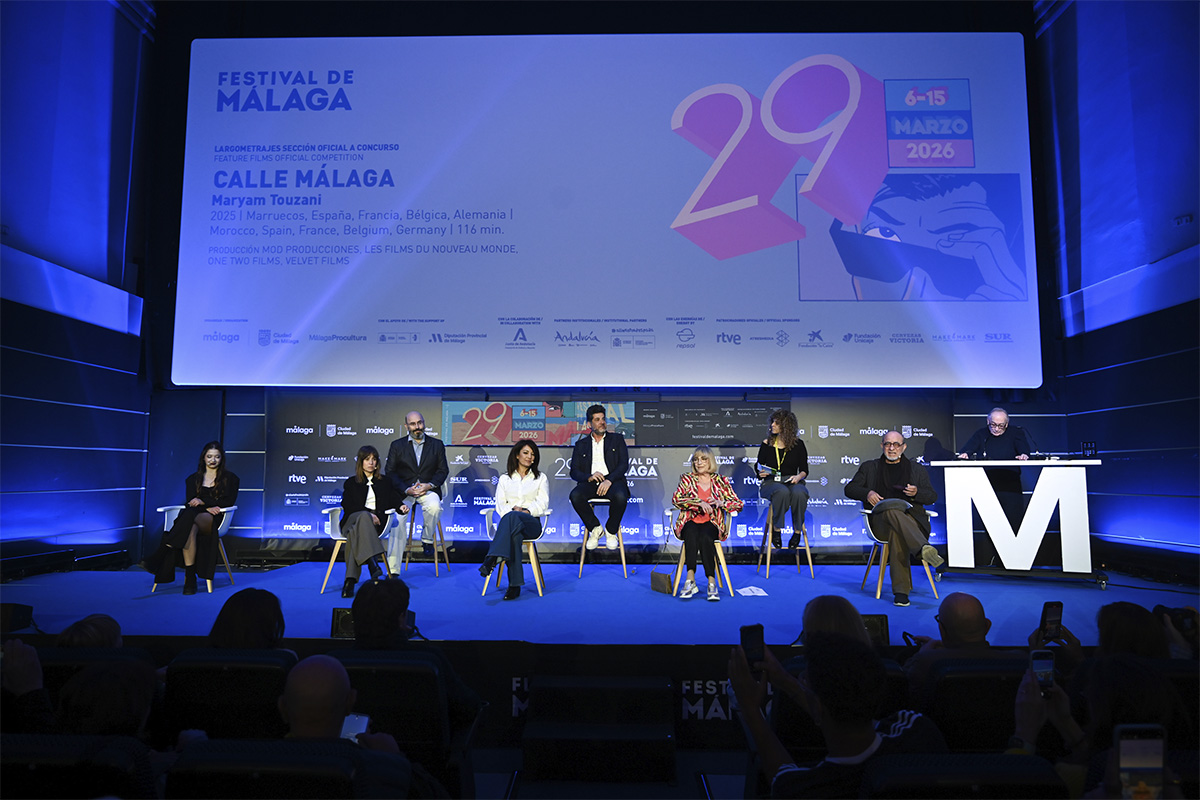
Moroccan director Maryam Touzani has presented her new feature film Calle Málaga (Malaga Street), a lively drama about uprooting, memory, belonging and desire in old age, starring Carmen Maura and Marta Etura, which opens the Official Selection of the 29th Festival de Málaga, where it will compete for the Golden Biznaga along with 21 other films.
This is a co-production between Spain, Morocco, France, Belgium, Belgium and Germany, in which Touzani explores the complexities of family ties through an intimate story based on her own experience and the deepest feelings she experienced after suffering the loss of her mother, who died suddenly three years ago.
Accompanied by actors Carmen Maura, Marta Etura, Ahmed Boulane and La Imèn at the press conference, the director explained that the film’s origin is linked to an intimate need to transform the suffering of her grief into a celebration of life. Touzani confessed that she wrote the script in tears, but subconsciously felt that she also needed to laugh. For this reason, she has taken great care to ensure that humour and suffering coexist organically throughout the scenes, allowing herself to be carried along by the characters and their own stories.
In her speech, Touzani outlined the key elements of her plot, which is based on roots, memory and identity, three key premises that reflect the lives of Spaniards living in the north of Morocco. To build the main character played by Carmen Maura, the Moroccan director drew inspiration from the memories of both her mother and her maternal grandmother, a Spanish woman who also lived in Tangiers, to whom she pays tribute.
She explained that the creative process was deeply emotional and allowed her to go through the different phases of grief. The narrative oscillates between past and present, in an intimate journey that mixes laughter, tears and the contradictory emotions of memory and family nostalgia.
The script depicts complex characters far removed from stereotypes, who evolve throughout the story, showing both their fragilities and their contradictions. The director opts for a close, almost intimate camera that accompanies the protagonists in their most vulnerable moments.
Its leading actress, Carmen Maura, has said that the only requirement for accepting a new job at the age of 80 is that she is enthusiastic about the script. Because when she read Touzani's she "cracked up", she decided to embark on this project, which she found both exhausting and exciting to shoot. She also had to undress in the film, but "she took it in her stride because she didn't care", confessing that "at this age I've learned that you have to do whatever you want to do".
In contrast, actress Marta Etura said that when she read the script, she thought her character to be "ugly and complex, because she was a woman who wanted to throw her mother out of her own house". However, as shooting progressed, she progressively empathised with her reality, beginning to understand that her character harboured a desperate woman, who was afraid of facing motherhood alone and was in a state of true emotional survival.
On her character, Etura also emphasised that she invites the viewer to make different interpretations. For the actress, there is a message that remains intrinsic throughout the feature film and which she feels is very necessary given the current international situation. "This story shows how lack of communication, dialogue and listening drives us apart; it reminds us all how necessary it is to listen," she insisted.
Touzani also highlighted that her film deals with universal themes such as belonging, second chances and the weight of the past, constructing a story that connects with the viewer from a profoundly human dimension. During the presentation at the Cine Albéniz, the cast highlighted the intensity of the creative process and the connection that was generated between the actors during the filming.
Producers Nabil Ayouch and Simón de Santiago underlined the commitment to filming in real locations, a decision that strengthens the authenticity of the project and its link with the territory. The story takes place in the Moroccan city of Tangiers, a setting that becomes another character, giving the work a very strong cultural identity through a series of elements.
Calle Málaga tells the story of María Ángeles, a 79-year-old Spanish woman who lives alone in Tangier, in northern Morocco, where she enjoys her daily routine and life in the city. Her peace of mind is shattered when her daughter Clara arrives from Madrid with the intention of selling the flat in which she has always lived. Determined to remain in the place she considers her home, María Ángeles will do everything she can to preserve it and recover the objects that hold the memories of a lifetime. In that process, against all odds, she rediscovers love and desire.
The film comes to the Festival de Málaga after an outstanding international tour that includes the Audience Award in the Spotlight section of the Mostra de Venecia. It has also been screened at leading festivals such as Toronto and Mar del Plata, where it was received with great acclaim by audiences and critics alike. This film is also Touzani's first film shot mostly in Spanish.
Share