Chile bursts onto the Festival de Málaga scene with 'Hangar Rojo', Juan Pablo Sallato's debut feature film that recounts Pinochet's coup d'état to build collective memory and prevent it from happening again
Following its premiere at the Berlinale, 'Hangar Rojo' is one of ten Ibero-American feature films competing in the Official Competition alongside twelve Spanish productions
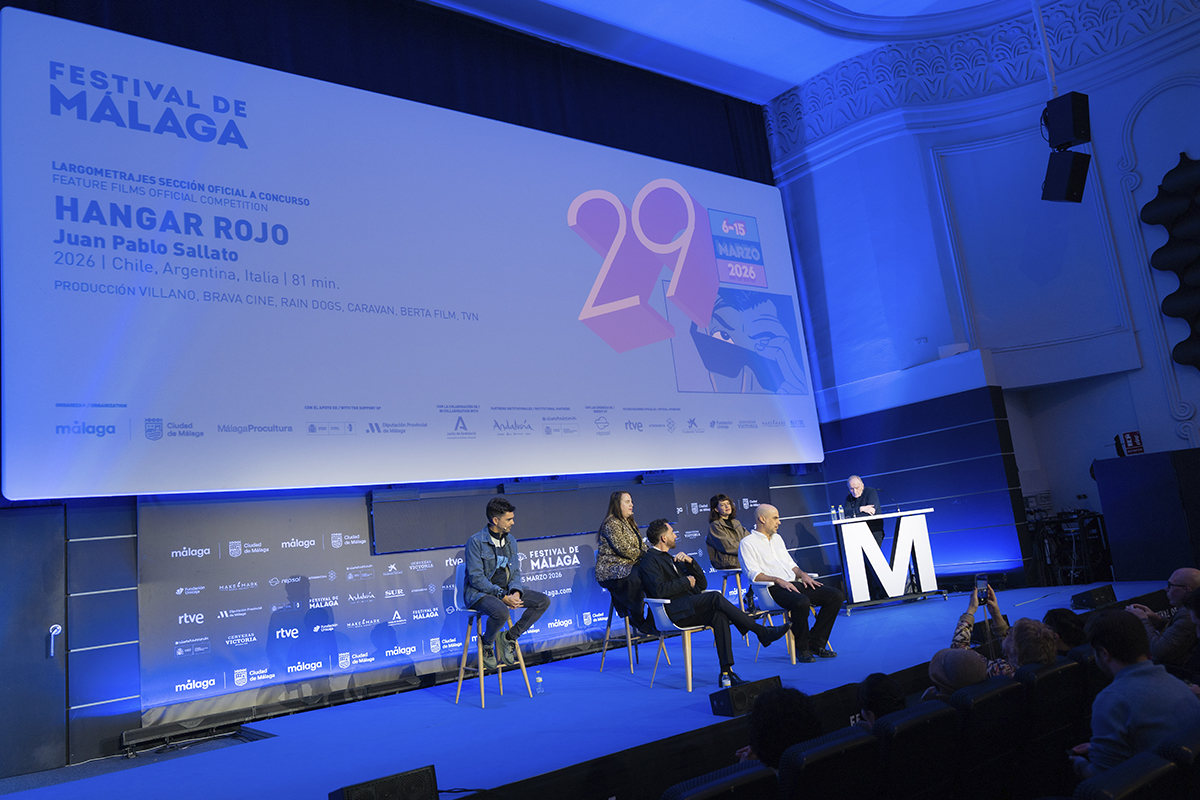
Chilean director Juan Pablo Sallato presented his feature film 'Hangar Rojo', a historical drama that recounts Augusto Pinochet's 1973 coup d'état, with the aim of building collective memory, breaking down prejudices, and preventing it from happening again.
In a press conference alongside the lead actor, Nicolás Zárate, the filmmaker revealed that the film's underlying message is particularly critical. Zárate and Sallato, who co-wrote the film with Borja Cobeaga, presented it this morning at a press conference during the Festival de Málaga, where it is competing in the Official Competition. They emphasised the importance of generating debate, conversation, and posing many open questions among viewers to combat the manipulation of reality by certain sectors of Chilean society.
This co-production between Chile, Argentina, and Italy marks Sallato's debut in the dramatic narrative format. The film focuses on the repression and torture suffered by numerous Chilean military personnel at the hands of their own comrades, primarily for refusing to support the coup d'état.
Based on the book Disparen a la bandada, by Fernando Villagrán, the film is inspired by the true story of Captain Jorge Silva—played by Zárate—who is ordered to transform the Aviation School where he teaches young cadets into a detention and torture centre.
The image in the book, in which the author depicts his journey to the La Moneda Palace immediately after the military coup, inspired Sallato to film the feature in black and white, colours that metaphorically represented the reality of the country.
The director explained that he wanted to focus on a character like Silva because he held a mid-level military position. He wasn't interested in high-ranking officers, but rather in portraying the dilemma, pressure, and fear of those who felt coerced by a hierarchical system. The screenplay arose from the need to tell a complex, multi-layered story.
Zárate, for his part, explained that he avoided portraying his character as a hero, opting instead to create an empathetic and very human being. To achieve this, he drew inspiration from literary characters like Hamlet. Actors Boris Quercia, Marcial Tagle, Catalina Stuardo, and Arón Hernández join him in the cast. Sallato also stated that for him, it was key that the characters be well-developed and defined to contribute to conveying maximum authenticity.
In a country on the brink of chaos, Captain Jorge Silva, 37, is assigned to a mission that will test his convictions. What begins as a duty becomes a moral dilemma when what should be a swift and effective action forces him to reconsider his own role within the machinery of power and barbarity. He must decide whether to obey his superiors' orders or act according to his conscience to save lives and confront the brutality of the historical context that surrounds him.
Following its world premiere in the Berlinale's Perspectives section, it is now competing in the Official Competition of the Festival de Málaga alongside 21 other Spanish and Latin American feature films.
Share