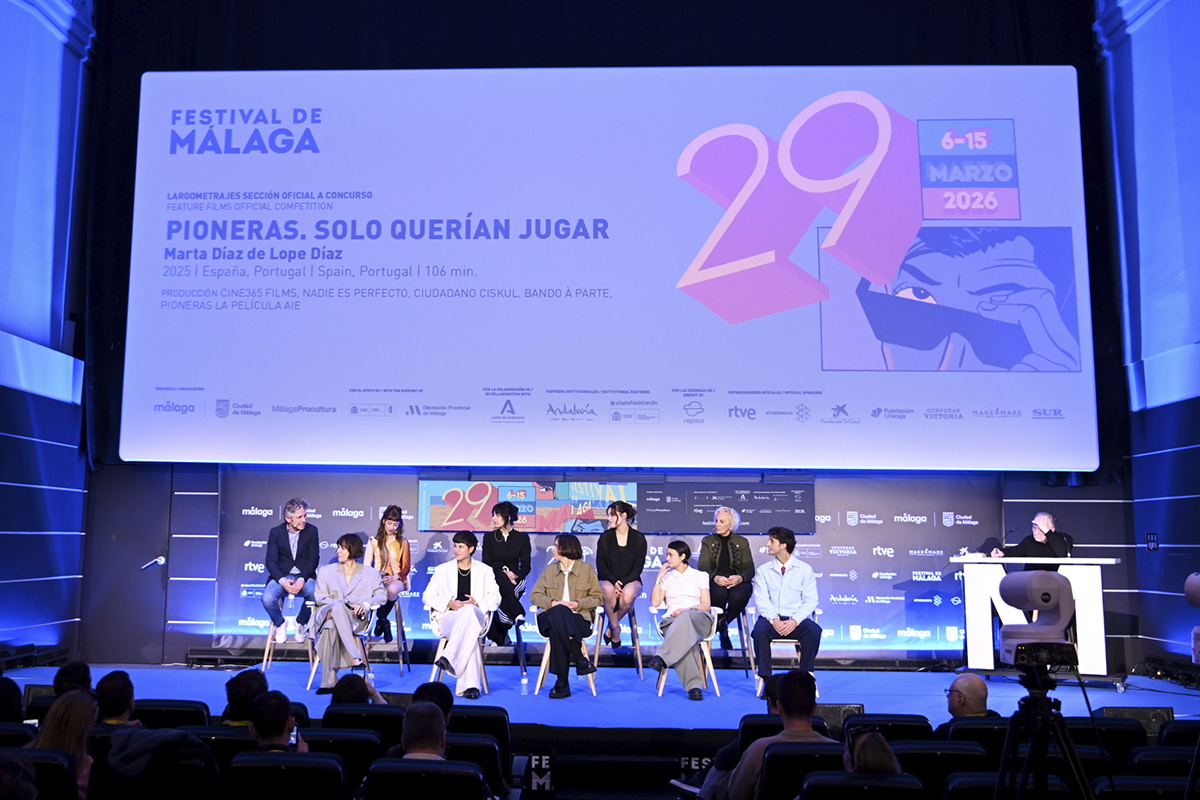
Pioneras by Marta Díaz de Lope Díaz arrives at the Festival de Málaga to vindicate the women who changed the history of Spanish football
The film is inspired by the story of the first Spanish women footballers who dared to play in the 1970s, despite discrimination and prejudice
The director Marta Díaz de Lope Díaz has presented Pioneras (Pioneers), her new film inspired by real events about the first Spanish female footballers who dared to play in the 1970s, despite discrimination and prejudice. After winning the Audience Award for her debut film Mi querida cofradía (My Dear Brotherhood) in 2018, she now returns to the Festival de Málaga to compete in the Official Competition.
At a press conference, Díaz de Lope Díaz explained that this feature film recovers a little-known story, that of the women who dared to form some of the first women's football teams in Spain, when doing so was still a cause for mockery, censorship and even prohibition. To this end, it sets out to revisit a forgotten part of recent history, and to pay tribute to those women who fought to occupy a space that was denied to them.
Inspired by real events, the film tells the story of a group of young people who defy the social norms of the time to play football and defend their passion for the sport. In a Spain still marked by prejudice, these players had to face insults, misunderstanding and institutional obstacles, but they also paved the way for future generations.
"The story of these players speaks of courage, passion and freedom. Not only did they want to play football, but they also wanted to show that they had the right to do so," said the director, after emphasising the symbolic value of presenting this film on International Women's Day.
The director also argued that the project seeks to connect the past with the present, and to remember that many of the current advances in women's sport are thanks to the efforts of those who paved the way decades ago. "Today we see full stadiums and girls dreaming of becoming footballers, but there was a time when that seemed impossible. This film is about remembering where we come from," she said.
During the preparation of the script, written with Zebina Guerra, Díaz de Lope had the opportunity to talk to some of those pioneers, whose personal experiences were fundamental to understanding how they experienced that period and to constructing the film's narrative.
The documentation phase was also key, when the director discovered numerous material resources that allowed her to reconstruct the context of the period, and which, as she explained, were particularly revealing. Among them, she mentioned archives of programmes such as La mujer ideal (The Ideal Woman), images of charity matches such as the one held in 1971 under the title Folclóricas contra Finolis (Folklorists versus Fancy-pants), as well as cultural references from those years, including the film Las Ibéricas F.C., and fragments from NO-DO. All these findings helped her to better understand the social atmosphere in which the first female footballers emerged.
Díaz de Lope explained that from the beginning it was clear to her that the film had to place the viewer in that historical context, so that they could understand why the apparently simple gesture of playing football had a much deeper dimension. In this regard, the script also deals with the role played by institutions such as the Women's Section and the Social Service, a structure which, as the director recalled, functioned in some way as a kind of compulsory service for women at the time.
The film's cast brings together a large cast headed by Daniel Ibáñez and Aixa Villagrán, along with young actresses Sofía de Iznájar and Bruna Lucadamo, who play some of the first female players who dared to break the social barriers of the time. The cast is completed by the actors Nora Otxoteko, Leire Aguilar, Lorea Carballo and Miriam Rubio, giving shape to a choral cast that reflects the collective strength of those pioneering women.
The cast also stressed the importance of cinema recovering stories that have been made invisible and contributing to the generation of new female referents. In this regard, the film takes a bright and moving look at the resilience and determination of a group of women who, without intending to, ended up changing the history of sport in Spain.
With a tone that mixes emotion, humour and a spirit of process, Pioneras. Solo querían jugar (Pioneers. They just wanted to play) aims to immerse the spectator in a journey to the origins of women's football in our country.
In Spain in the early 1970s, with Francoism still firmly entrenched in society, a group of very young girls decide to play football in a country that does not consider they have a place in the sport. Along the way they meet an unexpected ally: a sports promoter who is as bold as he is visionary. Together, and against all odds, they will challenge the system and lay the foundation stone of a struggle that continues to this day.
Share