Fernando González Molina reinterprets the 1972 classic 'Mi querida señorita' with a pedagogical intention on identity and intersexuality.
Javier Ambrossi and Javier Calvo produce this film, which lands in cinemas on 17 April and on 1 May on Netflix, and with which they are competing in the Official Selection of the Festival de Málaga.
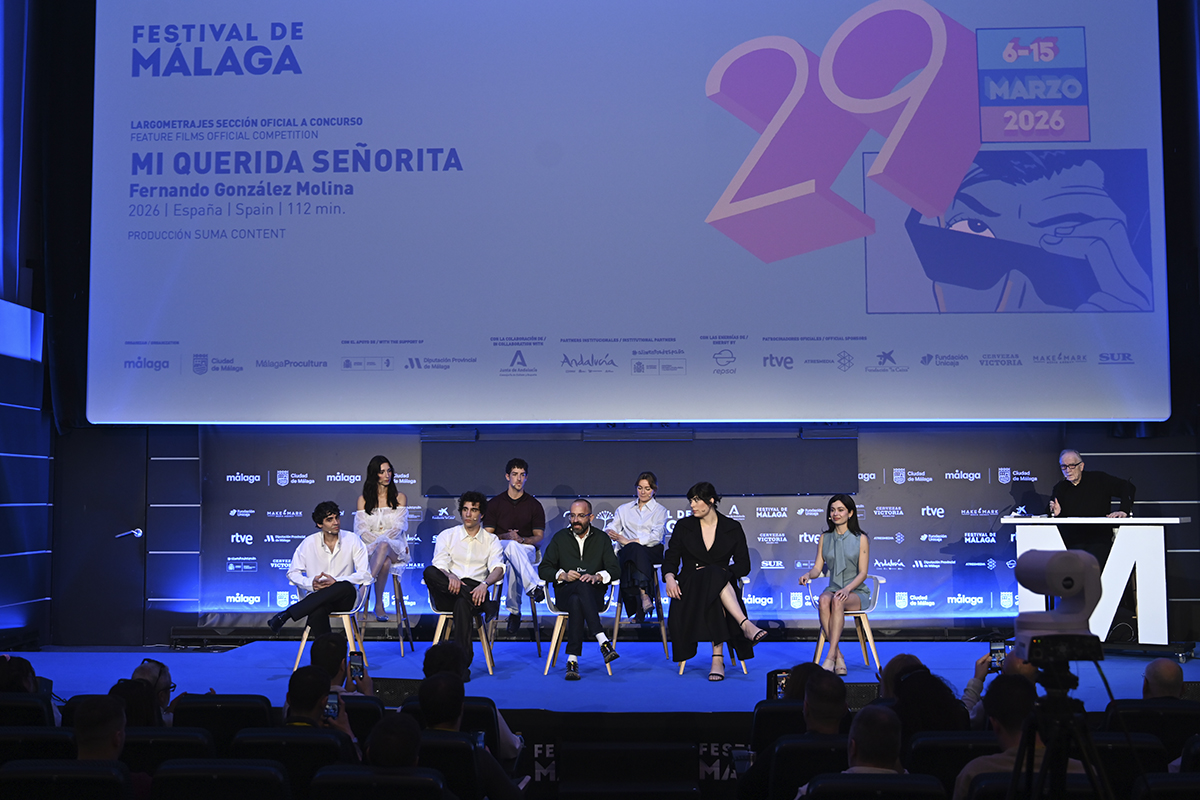
The director Fernando González Molina has presented the new feature film Mi querida señorita, his contemporary reinterpretation of the 1972 classic together with the producers Javier Ambrossi and Javier Calvo, with which they are competing in the Official Selection of the 29th Festival de Málaga.
This updated version of Jaime de Armiñán's film, nominated for an Oscar for best foreign film, has a clear pedagogical intention on identity and intersexuality. Both the director and his producers wanted everything to be explained clearly, so that spectators can understand his current view of love through the character of Adela, played by Elisabeth Martínez. "It is not only about discovering who you are, but also about knowing how to explain to others who you are," González Molina explained.
Adela is an intersex woman who begins a personal and emotional journey from a life marked by silence to the possibility of understanding herself and explaining herself to the world. "It's a person who lives in a cage and suddenly realises that so many layers have accumulated that they don't know how to get out of it. When she comes out, she will break with everything, make mistakes and progressively rebuild each of the layers," said lead actress Elisabeth Martínez.
The filmmaker has stated that the film is born with a clear desire for dialogue with the audience. Far from going for gimmicky twists, the director focuses on a narrative based on emotion and character building. "There are no surprise scenes to attract attention. It is a story to fall in love with the characters, with a message that makes it clear that you can always start from scratch, until you find your place," he explained. The script, written with the author Alana S. Portero, also seeks to give visibility to historically silenced realities such as homosexuality and intersexuality, using film as a space for representation and social understanding.
Anna Castillo, Nagore Aranburu, Lola Rodríguez and Manu Ríos highlighted the profoundly human nature of the characters, whom they described as very lively, chaotic and different from one another, a diversity that reflects the different ways of facing identity, love and the desire to belong. Eneko Sagardoy, María Galiana, Delphina Bianco and Paco León complete the cast.
On the other hand, the whole team insisted that there is an important message for young people, claiming the importance of being able to name themselves, understand themselves and find spaces where these identities can be shared and recognised.
Shot between Pamplona and Madrid, the story follows the emotional journey of its protagonist as she discovers new friendships, affections and life possibilities, in a process where love, art and community become tools to understand who she is and where she belongs.
Adela, the lonely only child of a conservative family, spends her days between the family antique shop and the catechism classes she teaches, marked by her mother's protection and silence about her intersexuality, which she is unaware of but which conditions her life. An unexpected and beautiful friendship with a newly arrived priest, the return of a great childhood friend and the appearance of a woman, Isabel, set off a chain reaction that leads Adela on a journey in search of herself, from Pamplona to Madrid, where her identity will need the love and help of others to reveal itself.
Share