The Festival de Málaga celebrates 8 March with a meeting of leading figures in Spanish women's football
The colloquium ‘Gracias, pioneras’ (Thank you, pioneers) brought together historical and current figures to discuss the evolution of the sport and the ongoing challenge of equality
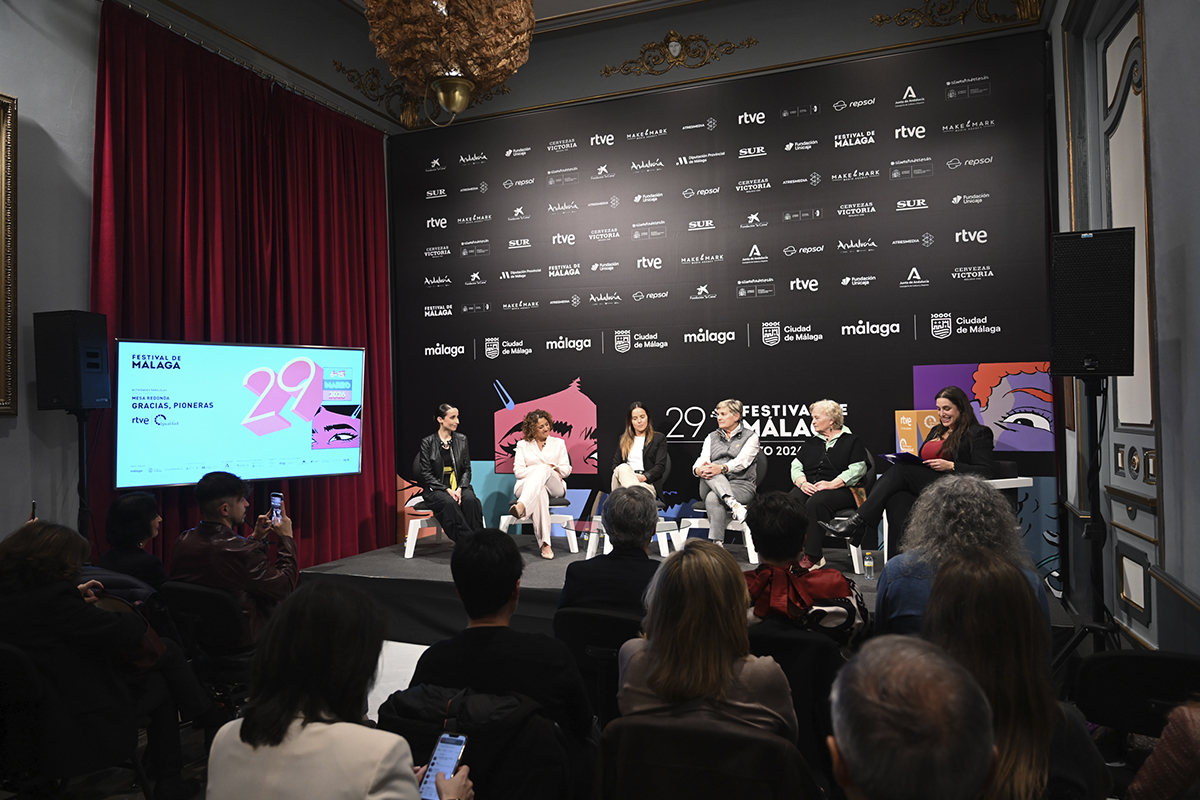
The Festival de Málaga commemorated International Women's Day on 8 March with the event ‘Gracias, pioneras’ (Thank you, pioneers), a round table discussion held in the Rossini Hall of the Cervantes Theatre. The event brought together key figures in Spanish women's football to discuss the evolution of the sport and the challenges in the fight for equality. This activity stemmed from the screening of the film ‘Pioneras. Solo querían jugar', by Marta Díaz de López Díaz, which is participating in the Official Competition.
The discussion included the participation of Carmen Arce ‘Kubalita,’ the first goalkeeper for the Spanish Women's National Football Team; Victoria Hernández, the first Spanish footballer to sign a professional contract in 1971; Claudia Zornoza, a World Cup champion with Spain in 2023; Beatriz Álvarez, president of the Women's League; and Zahara, singer-songwriter and author of several songs on the soundtrack of the film Pioneras. The panel was moderated by Beatriz Aparicio Vinacua, head of the Equality Observatory unit.
Carmen Arce began by offering a snapshot of football during her time: “In 1971, we filled stadiums and played very well, but from 1980 onwards, there was an institutional blackout”, describing the period as contradictory. Victoria Hernández echoed this sentiment, noting that “there were families who didn't want their daughters to play football. Many did it in secret”.
Claudia Zornoza, representing modern football, acknowledged the significant changes the sport has undergone in recent years: "We used to play on dirt pitches, now we play on natural grass pitches and we have doctors, physiotherapists, and trainers”, although she admitted there is still much progress to be made. Similarly, Beatriz Álvarez pointed out that currently, 350 women in the Women's League can dedicate themselves exclusively to football.
Listening to the four speakers' highlights, singer Zahara explained that with the film's song, she wanted to convey everything she felt watching it and learning about the efforts of so many women who have fought so hard to achieve their dreams.
The discussion also touched on the current paradigm shift. “Now girls want to be footballers”, declared Beatriz Álvarez. This led to a debate about the lack, or presence, of role models, which Carmen Arce highlighted by pointing out that it wasn't a lack of role models, but rather that the limited visibility of women's football predecessors led current athletes to believe they had no one to idolise. "We laid the groundwork so that today's female footballers could be where they are", added Victoria Hernández.
With this event, the Festival de Málaga joined in the celebration of International Women's Day, bringing together women who have marked different stages in the history of women's football in Spain and reinforcing its commitment to equality in the cultural and sporting spheres.
Share