RTVE analyses its film and documentary support strategies at the 29th Festival de Málaga
Mercedes de Pablos moderated a conversation at the Museo Carmen Thyssen on project selection, female talent, and equality in the audiovisual sector
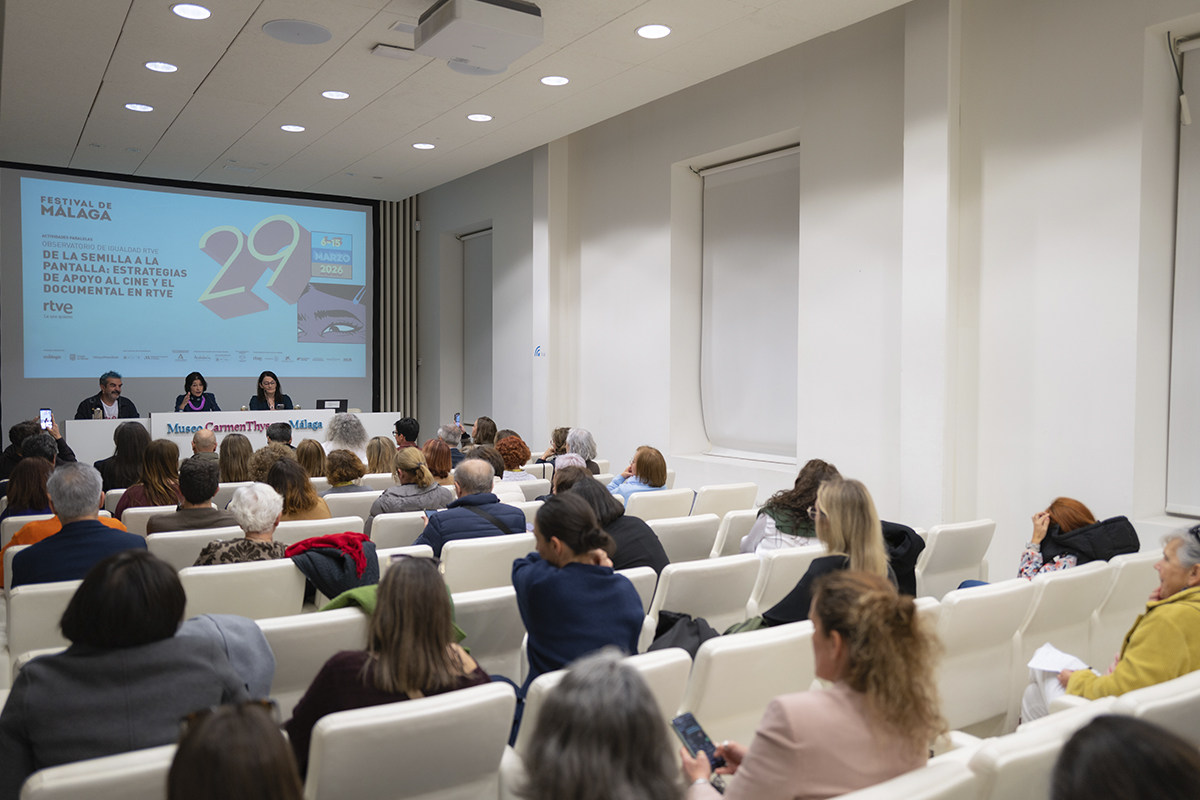
The 29th Festival de Málaga, organised by Malaga City Council through Malaga Procultura , held on Monday 9 March at the Museo Carmen Thyssen the round table 'From seed to screen: strategies to support film and documentaries at RTVE', promoted by the RTVE Equality Observatory.
The meeting, moderated by Mercedes de Pablos, president of the Observatory, served to share strategies for the selection of film and documentary projects at RTVE, and to reflect on the presence of women in the audiovisual sector, the creation of spaces of opportunity, and the promotion of female talent and equality.
Cecilia Fernández, executive producer of documentaries at RTVE, reflected on the presence of women producers in our country, pointing out that, in the documentary field, "the percentage is 50%". She considered these figures to be positive, given that, in the international context, between 30% and 40% of the documentaries made each year are directed by women. "I think we are up to the task. The Spanish audiovisual sector is very powerful right now," Fernández concluded.
Gervasio Iglesias, RTVE's Director of Cinema, pointed out that "something that is highly valued in the scripts is that the characters incorporate a woman's point of view". However, she expressed her concern that "women's budgets are still lower", a situation which, in her opinion, is "a big problem in the audiovisual sector". In this regard, Cecilia Fernández stressed that "the budget is key", as it is what facilitates the creation of powerful projects, and she also highlighted the work of associations such as the Andalusian Association of Women in Audiovisual Media (AAMMA) in the defence of women's rights in the sector.
Another of the issues addressed during the round table was the perspective that women bring to documentary filmmaking. In this regard, Gervasio Iglesias pointed out that "documentaries directed by women, both from the point of view of the script and the organisation, have a particular point beyond". For Cecilia Fernández, another important aspect is the way in which these projects are presented: "The creative point of view is always good, but the documentary must be read on many levels, not just as background or in a flat lined way".
Iglesias concluded that "the important thing and the real challenge is not the first film, but the second one, because it takes a long time to promote and, at the same time, it requires a deadline for the creation of the next one".
Share