Júlia de Paz presents 'La buena hija', a harrowing portrait of vicarious violence and the invisible wounds left by patriarchy
After winning Best Film at the Tallinn Film Festival, the film is now competing in the Official Competition at the Festival de Málaga
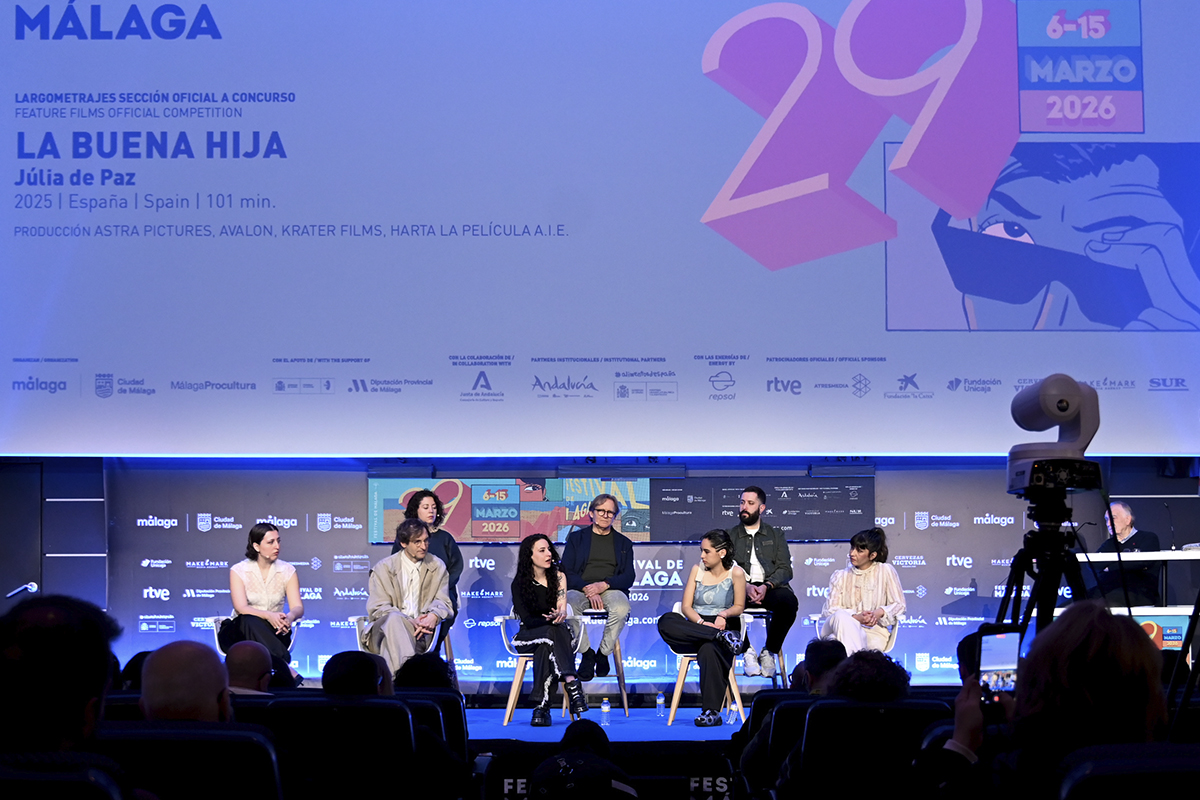
Director Júlia de Paz presented her new feature film, La buena hija, on Thursday, 12 March. The film is a harrowing portrait of vicarious violence and the invisible wounds left by patriarchy. After its run at the Tallinn Film Festival, where it won the Grand Prize for Best Film, as well as the Audience Award and the Best Actress award for its star, Kiara Arancibia, it now competes in the Official Competition of the Festival de Málaga.
At a press conference alongside the lead actors Kiara Arancibia, Julián Villagrán, Janet Novas, and screenwriter Núria Dunjó, director Júlia de Paz described her film—a co-production between Spain and Belgium—as an intense family drama that explores, through an emotional journey of love and heartbreak, how male and vicarious violence marks several generations. It also invites reflection on the possibility of breaking free from family mandates inherited through the passage of time.
The film follows the story of Carmela, a teenager who, after her parents' separation, moves with her mother to live with her grandmother. While trying to adapt to the new family situation, the young woman feels a deep admiration for her father, a visual artist with whom she longs to spend more time. However, the man's presence casts a disturbing shadow over the three generations of women in the family, forcing them to confront a reality marked by control, silence, and violence.
De Paz explained that her work stems from the need to focus on the consequences of gender-based violence on the children who grow up in that context. Thus, the screenplay, co-written with Nuria Dunjó, aims to explore how these children are often trapped in family and legal structures that continue to grant the abuser a position of authority, even when there is a history of violence.
The filmmaker revealed that this film required more than five years of research, during which she interviewed associations and victims of gender-based and vicarious violence. Her main conclusion was that the children were not being heard and that their rights were not being respected. And this was the primary motivation for making the film.
Regarding the title La buena hija (The Good Daughter), the director stressed that the concept of “being a good daughter” encapsulates a silent pressure that permeates the lives of many women from childhood. This concept stems from an implicit idea of fulfilling family expectations, protecting adults, or assuming emotional responsibilities that shouldn't fall on the children.
The goal, as explained by screenwriter Núria Dunjó, was to tell the story from the perspective of the young protagonist, showing the confusion that can arise when the abuser continues to occupy a central place in the children's emotional lives. For this reason, the script was constructed from this generational perspective, attempting to portray the emotional impact that gender-based violence has on the children who live with it.
For her part, the protagonist, Kiara Arancibia, highlighted the complexity of a character trapped between admiration for her father and the need to understand the consequences of his behaviour. Carmela's journey consists precisely of confronting this emotional contradiction and discovering the truth hidden behind the family's silences.
On the other hand, actor Julián Villagrán clarified that the film addresses the power dynamics that can take root within a family marked by violence. From his perspective, the film avoids simplistic portrayals, presenting characters full of ambiguity and contradictions that force the viewer to confront an uncomfortable reality.
La buena hija is Júlia de Paz's second feature film following the acclaim she received for Ama, which won the Feroz Puerta Oscura Award at the Festival de Málaga in 2021. It is inspired by her short film Harta, which won the Audience Award in the official short film section at the Festival de Málaga. This short film served as the starting point for this story about the lasting effects of abuse within the family.
Share