Álvaro Olmos Torrico presents La hija cóndor, an Andean epic about identity, tradition and the right to choose one's own destiny
After winning an award at the International Festival of New Latin American Cinema in Havana, this production between Bolivia, Peru and Uruguay is now competing in the Official Competition of the Festi
The Bolivian director Álvaro Olmos Torrico has presented his new feature film La hija Cóndor (The Condor Daughter), which is competing in the Official Competition of the Festival de Málaga. It is a poetic story that confronts the ancestral heritage with dreams of freedom, an Andean epic about identity, tradition and the right to choose one's own destiny, which includes a message calling for the preservation of Quechua to protect its use in the contemporary world.
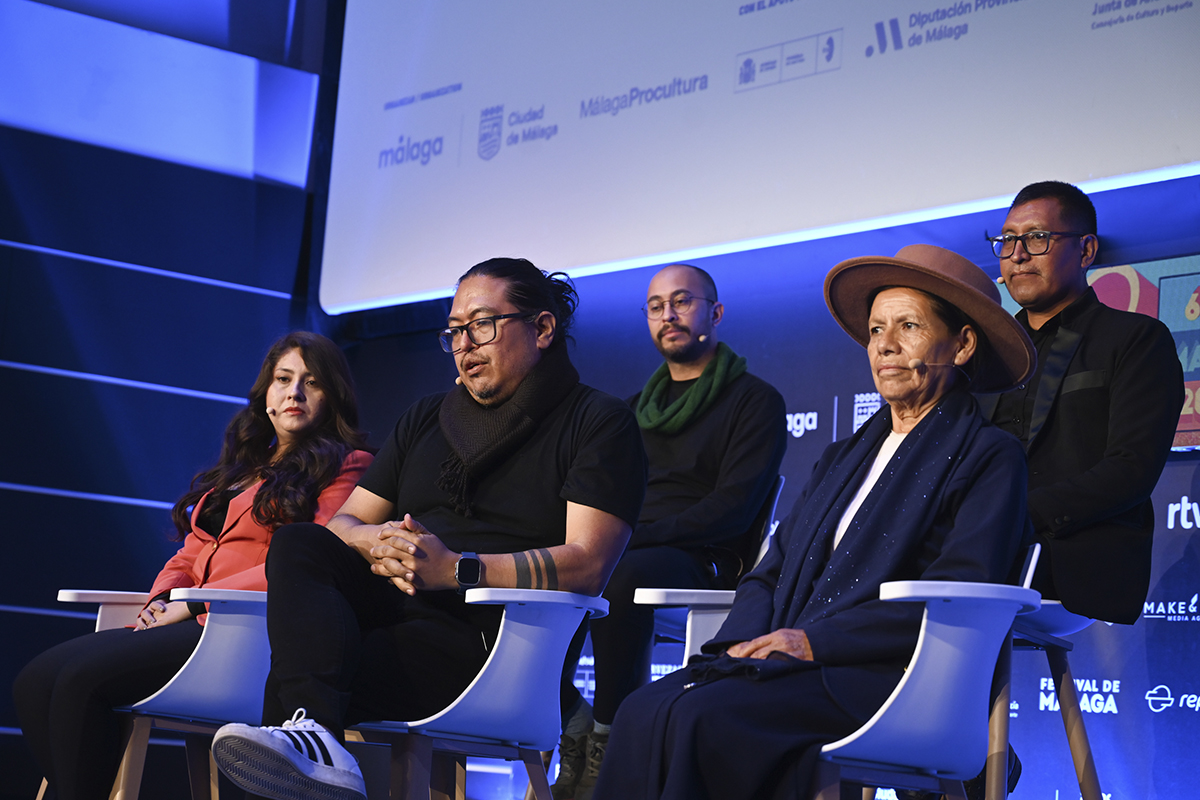
At a press conference with the leading actresses, María Magdalena Sanizo and Iris Sigalit, Olmos Torrico revealed the keys to this co-production between Uruguay, Bolivia and Peru, which combines indigenous tradition, music and a profound reflection on identity.
Set in the Bolivian Andes, the film immerses the viewer in the life of Clara, a young woman who has inherited from her adoptive mother the ancestral craft of midwifery and the knowledge of the ritual chants with which the women of her community accompany childbirth. However, the main character dreams of leaving her village and becoming a folk singer in the city, a desire that triggers a conflict between collective tradition and individual aspiration.
The filmmaker explained that the catalyst for his feature film was his interest in exploring the Andean cosmovision and the tensions experienced by many indigenous communities in the face of social and cultural changes. In this way, the story attempts to capture the moment when a person must decide between continuing an ancestral legacy or forging a path towards a different life.
About his characters, the director emphasised that Clara - played by María Magdalena Sanizo - represents precisely this crossroads between belonging to a community and the need to build her own identity. For this reason, he has striven to capture the tension that run through many contemporary histories in Latin America, where new generations seek to redefine their relationship with inherited traditions.
For his part, Sanizo focused on the symbolic dimension of the story and the way the film uses music as a fundamental narrative element. For her, the songs that appear in the story are not only part of the cultural universe of the community, but also reflect the spiritual bond that unites women with nature and the cycles of life.
The actress also highlighted the interpretative challenge of working with a character deeply connected to her environment and to a very specific cultural imaginary. From her perspective, the film proposes a respectful and emotional look at indigenous traditions, moving away from the stereotypes with which these communities have often been portrayed in cinema.
Her co-star, Iris Sigalit, said that the feature film is also about dreams and the need to make difficult decisions to pursue them. In this regard, she explained that the story shows how this desire for freedom can come into conflict with the weight of the community, generating personal dilemmas that run through the lives of the characters. Marisol Vallejos Montaño and Nelly Huayta complete the cast.
The director concluded that the film is built on strong visual and cultural contrasts, from the silence of the Andean landscapes to the noise of the city, and from ancient traditions to contemporary aspirations. This duality becomes one of the emotional driving forces of the story and the axis of the main character's evolution.
With a setting that combines breathtaking landscapes, traditional music and a deeply human story, the film takes us on an emotional journey about identity, memory and the price of following one's dreams. After winning an award at the International Festival of New Latin American Cinema in Havana, this Ibero-American co-production is now competing in the Official Competition of the Festival de Málaga.
Share