Buñuel's legacy and the feat of Plus Ultra come to the Festival de Málaga
Four titles were screened on the sixth day of the Special Documentary Sessions
The 29th Festival de Málaga reaches its halfway point and four titles were screened in the Special Documentary Sessions: Uyariy, Memoria de los olvidados, El inventor del cine invisible and Plus Ultra.
Winner of the Silver Biznaga in 2005 and a Goya Award for Best Documentary Film for Invisibles, Javier Corcuera returns to the Festival de Málaga to present his new documentary, Uyariy, meaning "to listen" in Quechua (the Andean language).
A co-production between Peru and Spain, the film addresses the massacres of 2022-2023 in Quechua and Aymara territories following the social uprising in Peru. A conflict that left 50 civilians dead during the repression of anti-government protests. Its premiere in the Andean country was marked by accusations of censorship, cancelled screenings, and restrictive showtimes.
Present at the Festival de Málaga, Javier Corcuera explained the documentary's filmmaking process: “This film arose as an emergency response during the massacre in Peru.
There was no intention to make a film, but rather to document what had happened. Little by little, the idea for a feature film grew until finally one of the protesters told us, ‘They've been killing us for 200 years.’ That's when we realised that this has been happening for years and that these injustices needed to be brought to light.”
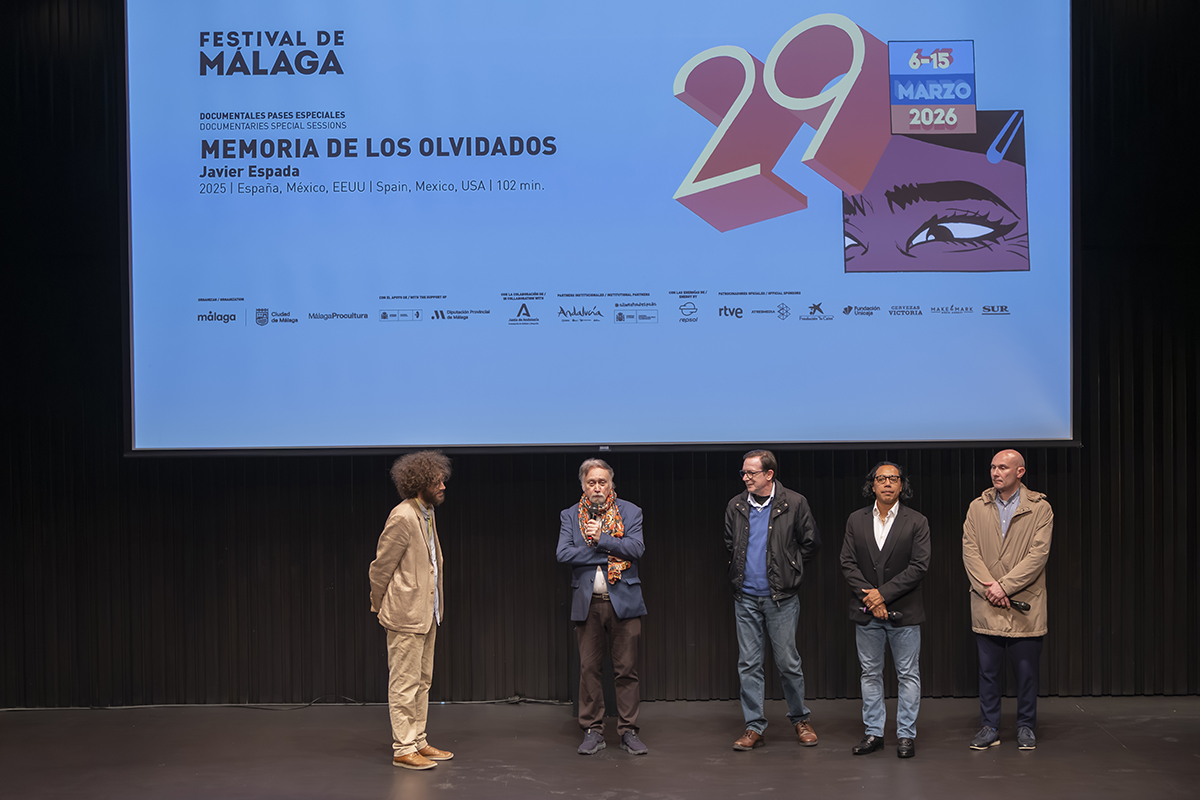
Also addressing the theme of social commentary was Memoria de los olvidados, (Memory of the Forgotten), the recent work by Aragonese filmmaker Javier Espada. A specialist in the work of Luis Buñuel, Javier Espada brings to the Festival de Málaga a documentary about one of the most important films in the history of cinema: Los olvidados, directed by Luis Buñuel in 1950 and inscribed on UNESCO's Memory of the World Register.
In Memoria de los olvidados, Javier Espada returns to the locations where Buñuel's iconic film was shot, sharing conversations with researchers and filmmakers who were deeply affected by the film. The film reflects years of research into the life and work of the filmmaker who went into exile in Mexico to contribute to the history of cinema with his personal style and by overcoming the limitations of the industry at the time.
“It’s a very special documentary in which I’ve tried to get people to revisit Los olvidados. I’m sure our documentary can help all creators, filmmakers, and writers because it rescues a very inspiring story. Los olvidados is a film that created a cinematic genre,” Javier Espada told the audience, dedicating the screening to the children of Gaza, “because we need them.”
Continuing with the screenings in the Special Documentary Sessions, the Christine Ruiz-Picasso Auditorium hosted the premiere of El inventor del cine invisible, a documentary by Manuel Jiménez Núñez about Guillermo Jiménez Smerdou, the journalist from Málaga who, until his death at age 98, was the oldest active journalist in Europe.
"Making a documentary involves giving thanks. So, the first thing is to thank Guillermo, who opened his home to me on one condition: not to exaggerate his life story. So that you can see his composure and his character. He was an admirable man,” said the director, known for telling the stories of figures worthy of rediscovery, as in his documentary series about the Sinsombrero, Spanish women artists, intellectuals, and thinkers of the Generation of '27.
Until his death, Smerdou had published more than 8,000 film reviews, thousands of articles and reports, hosted a successful radio programme for over 30 years, contributed to almost all Spanish newspapers, spearheaded the creation of a film festival, and invented the concept of “invisible cinema.”
An unforgettable legacy that was remembered by his son, Carlos Smerdou, upon receiving the Special Biznaga Award from the mayor of Málaga, Francisco de la Torre, during the documentary's presentation. “None of us have seen the documentary premiering today, but we are convinced it will be a very human portrait. Thank you to the entire team for the enormous affection you showed my father, who unfortunately hasn't been able to enjoy it, so let's do it for him.”
Also reclaiming forgotten events, the young director Elías Pérez presented his first feature-length documentary, Plus Ultra, in Málaga. It recounts the feat of four Spanish aviators who, 100 years ago, crossed the Atlantic in a single plane, flying from Palos de la Frontera (Huelva) to Argentina. An unprecedented achievement that embodied the visionary spirit of an era marked by technological advances and collective dreams.
Plus Ultra portrays this historic event of 1926, silenced by political tensions, when four military officers with opposing ideologies shared a cockpit to carry out a feat that transcended sports.
"It was a historic journey but totally unknown to many people. I'm from Huelva, and there's a street called Plus Ultra, and that caught my attention. I started researching those turbulent times in Spain when four men wanted to make history. For us, recovering this feat was quite a challenge,” confessed the director, who attended the documentary's premiere accompanied by actors Ignacio de la Puerta, Paco Márquez, Pablo Bejar, and producer Agus Jiménez.
Share