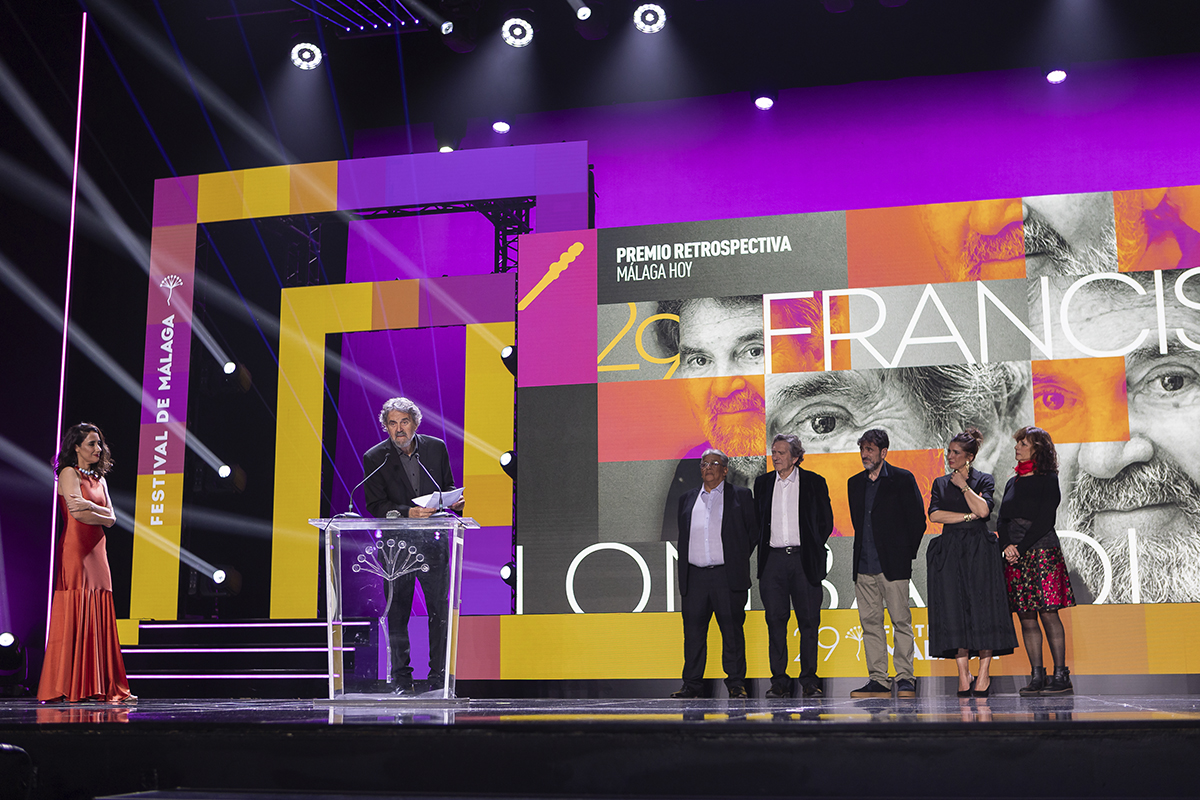
Francisco Lombardi receives the Retrospectiva - Málaga Hoy Award surrounded by friends and colleagues
The Festival de Málaga pays tribute to the Peruvian filmmaker, one of the key voices of Latin American Cinema, in a moving ceremony presented by Elisa Zulueta
The Festival de Málaga, organised by Malaga City Council through Málaga Procultura, has presented the Retrospectiva – Málaga Hoy Award of its 29th edition to Peruvian filmmaker Francisco Lombardi in a ceremony held at the Cervantes Theatre. The event brought together friends, collaborators, and admirers of the director to recognise a career that has profoundly marked the history of Latin American cinema.
Actress Elisa Zulueta hosted the event, which highlighted Lombardi as one of the most influential voices in Latin American audiovisual media, a creator whose filmography has explored the recent history of Peru, its social tensions, and its contradictions with a critical eye and artistic sensitivity.
During the gala, an audiovisual piece was screened that reviewed the director's extensive career, which began in 1977 with his first feature film, Muerte al amanecer (Death at dawn). Since then, Lombardi has built a filmography that is fundamental to Peruvian cinema, characterised by his ability to combine artistic ambition with a connection to the audience.
One of the great milestones of his career came in 1985 with his adaptation of La ciudad y los perros (The City and the Dogs), the celebrated novel by Mario Vargas Llosa, which was selected for the Directors' Fortnight at the Cannes Film Festival and earned him the Silver Shell for Best Director at the San Sebastián Film Festival.
Throughout his career, Lombardi has portrayed some of the key moments in Peru's recent history, addressing themes such as military hierarchies, social inequalities, and collective memory. His commitment to film as a tool for reflection has earned him accolades such as the Human Rights Watch Irene Diamond Award for his defence of human rights, the Pablo Neruda Order of Merit Medal, the National Culture Prize from the Government of Peru, and his induction into the Academy of Motion Picture Arts and Sciences.
The ceremony also featured the participation of several of the filmmaker's collaborators and friends, who took to the stage to offer words of tribute.
Producer and director Gerardo Herrero recalled his first meeting with the filmmaker in Lima in 1988. "Between that year and 2000 we made a lot of films together: La boca del lobo, Caídos del cielo, Bajo la piel, Pantaleón y las visitadoras and Tinta roja. These films portray Peruvian society very well. Never has a filmmaker portrayed his country so accurately.”
Producer Mariela Besuievsky highlighted the influence that Lombardi's cinema has had on her professional career. "La boca del lobo was a touchstone for me. Life brought us together again when I came to work in Spain. The first film I made after arriving was Bajo la piel, and since then we've shared many projects and moments. What I admire most about him is his love for cinema and for films.”
Actress Lucía Jiménez recalled her experience working with Lombardi on No se lo digas a nadie, when she was still very young: “I played a Peruvian woman, which was quite a challenge for me. Pancho is a very talented director who exudes calm and confidence. It's a pleasure to work with him. Later, we made Tinta roja together, and since then, a part of my heart has been Peruvian.”
Cinematographer Gustavo Sánchez highlighted the filmmaker's impact on his personal and professional life. “He’s the director I’ve worked with the most. I started with him almost 40 years ago in La boca del lobo. I have a special affection for him,” he affirmed, and addressing the honoree, added: “You’ve had a tremendous influence on my life as a director and also on my personal life.”
Finally, cinematographer Teo Delgado, who also presented the award, recalled his long professional and personal relationship with Lombardi: “I met him 40 years ago and I’ve been fortunate enough to work with him on 13 films. We were united not only by work, but also by a friendship that even football has helped to strengthen. I feel privileged to be able to be at this tribute and present this recognition to Pancho, who is a leading figure in Peruvian, Latin American, and world cinema.”
After the speeches, Elisa Zulueta introduced the presentation of the award. Amid applause from the audience, Francisco Lombardi took to the stage to accept the Retrospectiva - Málaga Hoy Award.
In his acceptance speech, the filmmaker wanted to share the recognition with all the professionals who have been part of his career. “I want to celebrate this special moment surrounded by such dear friends who have collaborated with me. Listening to them and being with them is especially moving,” he said.
Lombardi also emphasised the collaborative nature of filmmaking: "Filmmaking is a very collective endeavour. Receiving an honour like this might give the impression that one has achieved it alone, but after almost fifty years of making films, there are a huge number of people who have accompanied me: actors, technicians, assistants… Without them, my films couldn't be made.”
During his speech, the honoree also remembered some of the collaborators who have shaped his career, including the writer Mario Vargas Llosa, several of his screenwriters, the producer Gustavo Sánchez, the cinematographer Teo Delgado, the editor Eric Williams, and the actors Gustavo Bueno and Enrique “Franco” Aurelio, in addition to thanking his family for their support.
“I share this honour with all of them,” the director concluded, also dedicating a few words to his partner and children.
With this recognition, the Festival de Málaga celebrates the career of one of the great names in Latin American cinema, whose work has decisively contributed to building a profound and complex cinematic portrait of contemporary Peruvian society.
Share