The 5 Minutos section presents the films El caso minotauro, Hetero and Taranta at the 29th Festival de Málaga
On 12 March, the UMA rector’s office will host three productions that explore identity, displacement and social reality
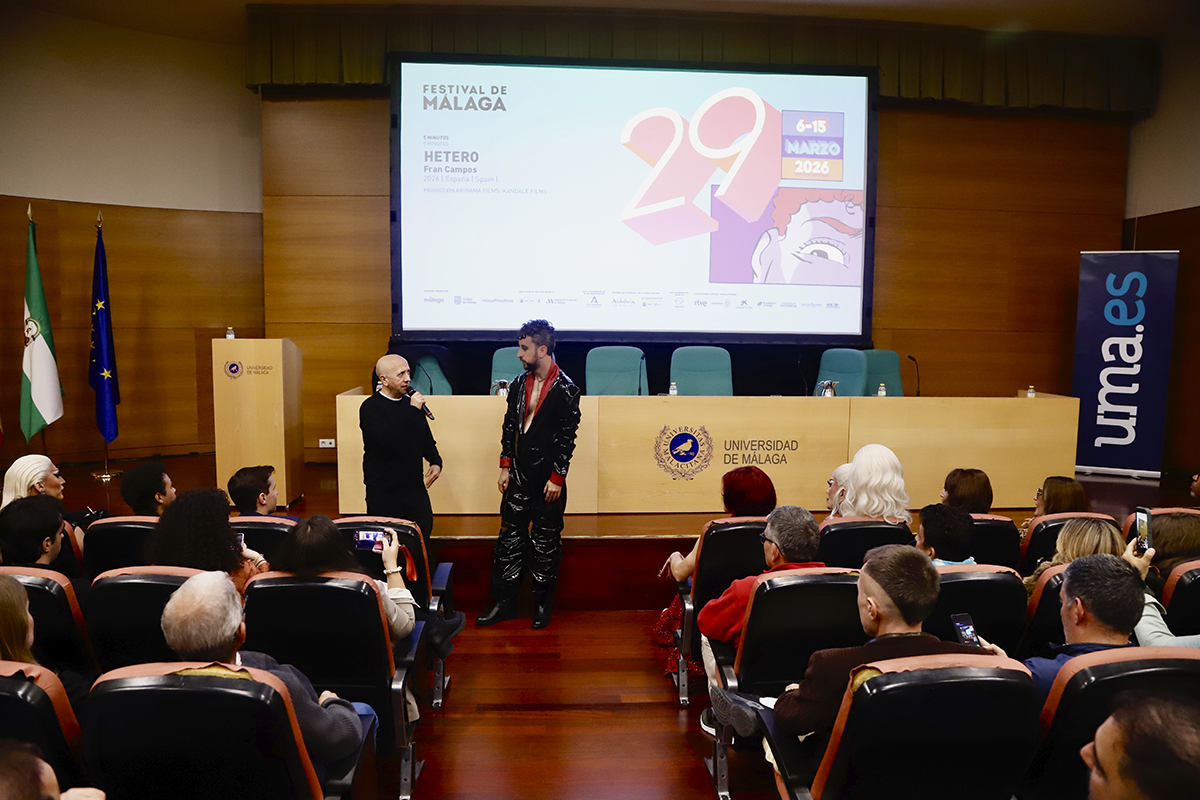
The 5 Minutos section of the 29th Festival de Málaga held a new session on Thursday 12th March at the rector’s office of the University of Malaga, where the projects El caso minotauro, by Silvana Tomeo; Hetero, by Fran Campos, and Taranta, by Samuel Nácar, were presented.
The exploration of sexual identity, the search for freedom, rural exodus and the social consequences of precariousness were the focus of a session marked by a diversity of approaches and themes.
The day began with Silvana Tomeo's thriller El caso minotauro, in which a city is terrorised by the Minotaur. Police officers Luis Santos and Ricardo Luna are on its trail, but Ariadna, its latest victim, is still missing. Clara Renard, the killer's psychologist, joins the search.
The director, Silvana Tomeo, explained that this project was a long time in the making. "It is a film that encourages reflection on who is to blame: the murderer, the body or the mind, and raises the question as to what extent we all have a beast inside us, what button activates it, and how far we may go," she said. In the same vein, the leading actor, Christian Zaiga, underlined the international ambition of the project, assuring that it is a film "that is going to be the talk of the town".
"The characters, in general, have many layers and a lot of duality. For an actress, playing a role with so much duality is a real treat", said Elena Martínez, who also wanted to highlight the influence of having a female director in the construction of her character. "Having a female director also had a big influence on the construction of my role. More women are needed," she added.
For his part, producer Ezekiel Montes said that this is one of the most important projects they have promoted so far. "It's Silvana's first film in Spain and I think it's a major undertaking," she said.
According to Fran Campos, Hetero is his most personal project. The film invites us to reflect on the acceptance of identity, and focuses on the need to face our fears to achieve freedom. Campos reminded the audience that even today, for many LGTBIQ+ people the process of acceptance is still particularly complex. "Damage is suffered by those who are discovering who they are. And that is precisely what happens to Fran Burgos' character, growing up in an environment of denial", said the director from Malaga.
In Hetero we meet Lenny, an introverted young man who is hard on himself because of who he is, until he meets Ariel, a co-worker at his new summer job a young Dominican extrovert who will change his perception of himself and the world around him. Fran Burgos, who stars in the film, explained that getting into character was a challenge and he "found it hard to get into the swing of it". Actress Mariví Carrillo, had a similar experience. In the film, she is the antagonist, a mother who refuses to accept her own son. "I'm sure we all know someone like that and it was a challenge to portray her without making her a caricature," Carrillo remarked.
The 5 Minutos section culminated with the new project by journalist and photographer Samuel Nacar. Taranta, he said, "is a portrait of the world around the Santana factory in Linares, following its inhabitants as the city undergoes an unusual process of reindustrialisation".
Currently in the editing phase, the film follows four young people - two locals and two Chinese engineers - as the old Santana factory, a symbol of the city, reopens its doors.
Against this backdrop, the protagonists are torn between staying and embracing this new industrial era, or leaving, taking with them their working-class pride, the memory of decline, and generational mistrust.
Nácar explained that his interest in this story stems from a generational experience. "I belong to the generation of 2008, when no matter how hard you looked for a job, there was always a ceiling," he said. From that point on, he began to explore an issue which, in his view, stems from the lack of industrialisation and its social consequences.
The director stated that the project serves to talk about "a problem that exists in many parts of the world, in cities where homelessness rules", expressing his concern about the disappearance of the working class, the deterioration of the welfare system, and the precariousness of working conditions. "In this project we question the normalisation of an eight-hour working day, the poor quality of life, low wages and rising prices. The problem stems from the economic model", he concluded.
Share