The legacy of García Lorca, Forqué and Val del Omar takes centre stage on the first day of the Documentary Special Sessions
Seven films were presented at this Saturday's Special Sessions of the 29th Festival de Málaga
On its second day, as part of the Documentary Special Sessions, the Festival de Málaga presented a selection of titles featuring prominent figures from Spanish culture, ranging from the poet Federico García Lorca to the filmmaker Val del Omar and the work of José María Forqué. In total, seven titles were presented to the Malaga audience, who gave these screenings a warm welcome.
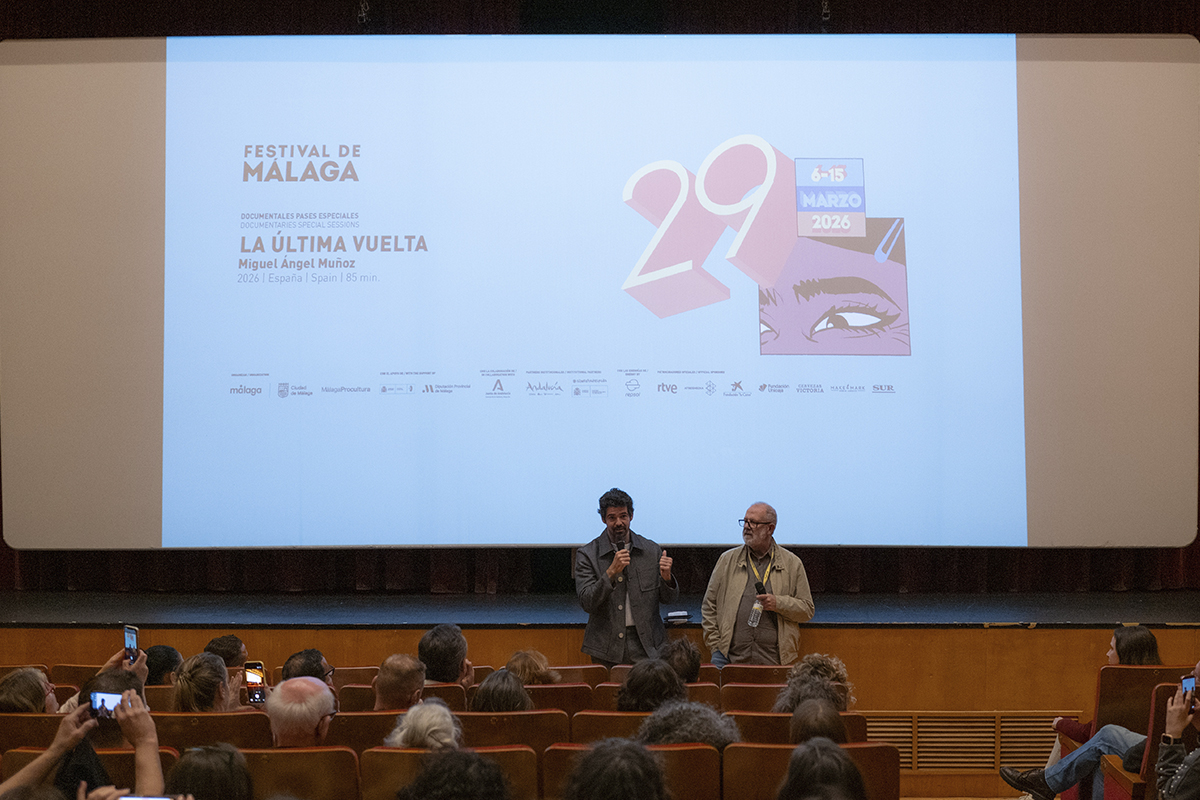
The day began with the screening of La última vuelta (The Last Lap), the new project by Spanish actor and director Miguel Ángel Muñoz, at the Centro Cultural María Victoria Atencia (MVA). In this edition of the Festival de Málaga, Miguel Ángel Muñoz shows one of the most painful moments of his life, the death of his "Tata", Luisa Cantero, at the age of 98. A transcendental moment for the actor as she passed away in the middle of the championship in which he was participating. With a career spanning more than 30 years, Miguel Ángel Muñoz decided to begin his career as a documentary director in 2021 with 100 días con la Tata (100 Days with Tata), which won the Forqué Award and was nominated for the Platino Awards, among others.
In the meeting with the Malaga audience after the screening, Muñoz explained that this project arose from a personal need, in a year when death "was with me a lot because I was risking my life in racing and my way of escaping the pain was through car racing". During this grieving process, Miguel Ángel Muñoz faced one of his greatest challenges as an actor: filming everyday life as if the camera were not there. Muñoz defines the project as a vital process, and one for which he "thanks the good and the bad".
Meanwhile, not far from the MVA, in the Christine Picasso Auditorium, the artist Miguel Poveda presented his documentary film Enlorquecido: solo el misterio nos hace vivir (Lorca madness: only mystery makes us live), in which he retraces the paths taken by Federico García Lorca.
With a script by Alberto Conejero based on texts by García Lorca and the voice of Juan Echanove playing the poet from Granada, the documentary shows an intimate and artistic quest in which Poveda, deeply connected to the figure of Federico García Lorca, seeks answers in the places where the poet once lived, to explore what remains hidden and, in turn, finding himself.
Over the course of several years, Poveda visits the cities that marked the author of Poeta en Nueva York: Granada, Madrid, Buenos Aires, Cadaqués, Montevideo, Havana, among others. At this crossroads between past and present, between Lorca and Poveda, an intimate, unexpected and profoundly revealing connection emerges.
"For us poetry lovers, the figure of Garcia Lorca is so magnetic, so strong that it shakes you up, it unsettles you", confessed the singer in the colloquium with the audience. Very moved by the reception of his film at the Festival de Málaga, Miguel Poveda, in tears, expressed his gratitude: "I am filled with gratitude and love for having been able to show in some way that there are more Lorquians like me. This 'Lorca madness' is not only mine. I'm glad to know that there are more people like me".
The presentation of Tríptico elemental de España (Basic Leaflet of Spain), the latest film project by the filmmaker José Val del Omar, took place in the Albéniz Cinema. Conceived as a trilogy dedicated to three "elementals", Aguaespejo granadino ( 1953-1955), Fuego en Castilla ( 1958-1960) and Acariño galaico (1961, 1981-82, 1995), the documentary is the last film that Val del Omar left unfinished and was completed after his death by the artist Javier Codesal, following Val del Omar's notes.
Inventor, visionary, visual poet and filmmaker, a term coined by Val del Omar himself to combine the activities of an alchemist and a filmmaker, thereby defining his approach to cinema, through technological research and his own experimental aesthetics, Val del Omar began his filmmaking activity in the 1920s.
After his death in 1982, his daughter, María José Val del Omar, and his son-in-law, Gonzalo Sáenz de Buruaga, founded the María José Val del Omar & Gonzalo Sáenz de Buruaga Archive with the aim of preserving, restoring, and disseminating the work of José Val del Omar. The Val del Omar Archive is currently chaired by Gonzalo Sáenz de Buruaga and directed by Piluca Baquero, who was present at the presentation of the documentary in Malaga, and who highlighted the importance of the filmmaker from Granada: "It is important to emphasise that Val del Omar founded the first special effects laboratory in Spain".
Continuing with the Documentary Special Sessions, the Echegaray Theatre hosted the presentation of the film Este cuerpo mío (This Body of Mine) by the Goya Award-winning actress Carolina Yuste. In this feature film, the actress documents the transition of her best friend, the Italo-Chilean filmmaker, screenwriter and queer activist Afioco Gnecco, who also co-directed the film. In a very intimate format, Yuste witnesses Gnecco's transition process, captured in the form of a filmed diary. "For me this film has been like therapy because returning to Chile as a man was a huge deal. My family is very fascist," Afioco confessed to the attending audience.
The actress and producer Sara Sálamo also uses intimate language to direct her recent feature film 'En silencio. The resilience of Isco Alarcón (In Silence. The Resilience of Isco Alarcón). Screened at the Christine Picasso Auditorium, the documentary portrays the most vulnerable moment of the footballer's career, after months away from the spotlight.
Having spent more than fifteen years as an actress in film and television, Sara Sálamo made the leap to directing to take control of the stories she tells. "After so many years in front of the camera I started with short films, but I didn't feel totally comfortable. One day I started researching sports documentaries and I felt I could make one about Isco's effort and hard work. For me it was like a love letter". The director was accompanied in the colloquium by her director of photography, Isabel Ruiz.
Far from the sporting spectacle, the film takes a close look at a wounded body and a mind in doubt. It is an honest and restrained portrayal of vulnerability, mental health and the weight of the audience's judgement.
The Christine Ruiz-Picasso Auditorium also hosted the presentation of Forqué, el oficio de hacer cine (Forqué, the Craft of Filmmaking), directed by Gaizka Urresti and Rafael Maluenda, about the prestigious Spanish director and screenwriter, José María Forqué.
Forqué, el oficio de hacer cine recovers the filmmaker's legacy through his own voice and that of actors and filmmakers who knew him. It is an intimate account covering everything from his successes in the 50s to his establishment as a master of comedy and television.
The director and scriptwriter, Gaizka Urresti, has stated that the production "vindicates the way of making films", as it speaks of a figure whose films have remained in the Spanish imagination. Urresti considered that "finding someone so humble speaks volumes about their attitude to life and to filmmaking, which makes all the difference when it comes to reaching the audience".
For his part, co-director Rafael Maluenda, the filmmaker and cultural manager, posed the question "How many filmmakers who talk about José María Forqué have actually seen his films?" This question gave rise to the idea of creating a documentary that would recover the legacy of one of the most important figures in Spanish cinema.
At the end of the day, the attending audience at the Festival de Málaga were able to see the documentary Leonas, el instinto más salvaje (Lionesses, the wildest instinct), the inspiring story of Majo Gimeno, founder of the association Mamás en Acción, and her team of volunteers, who accompany children in need of care and support when they are in a situation of neglect. The film shows how their commitment to solidarity can ignite hope where there seems to be none.
Directed by Juan Manuel Cotelo, it takes a close and hopeful look at the transformative power of love, exploring the capacity of this feeling and showing how it can transcend limits and change lives. "The big secret here is to look up and not just look at your navel. Do for others, not for yourself," Majo Gimeno encouraged the audience filling the Tourism and Sports Hall.
Share