Aquella sombra desvanecía (That Shadow Faded Away) brings to the Festival de Málaga an intimate story about the distance and silences between mother and son
Samuel Urbina's Peruvian film, premiered as part of the Zonazine section, explores family ties marked by migration and absence in the desert of Piura
The Zonazine section of the Festival de Málaga hosted the European premiere of Aquella sombra desvanecía, the debut film by Peruvian director Samuel Urbina, a slow-paced work that explores the emotional ties between a mother and her son through silences, absences and distances.
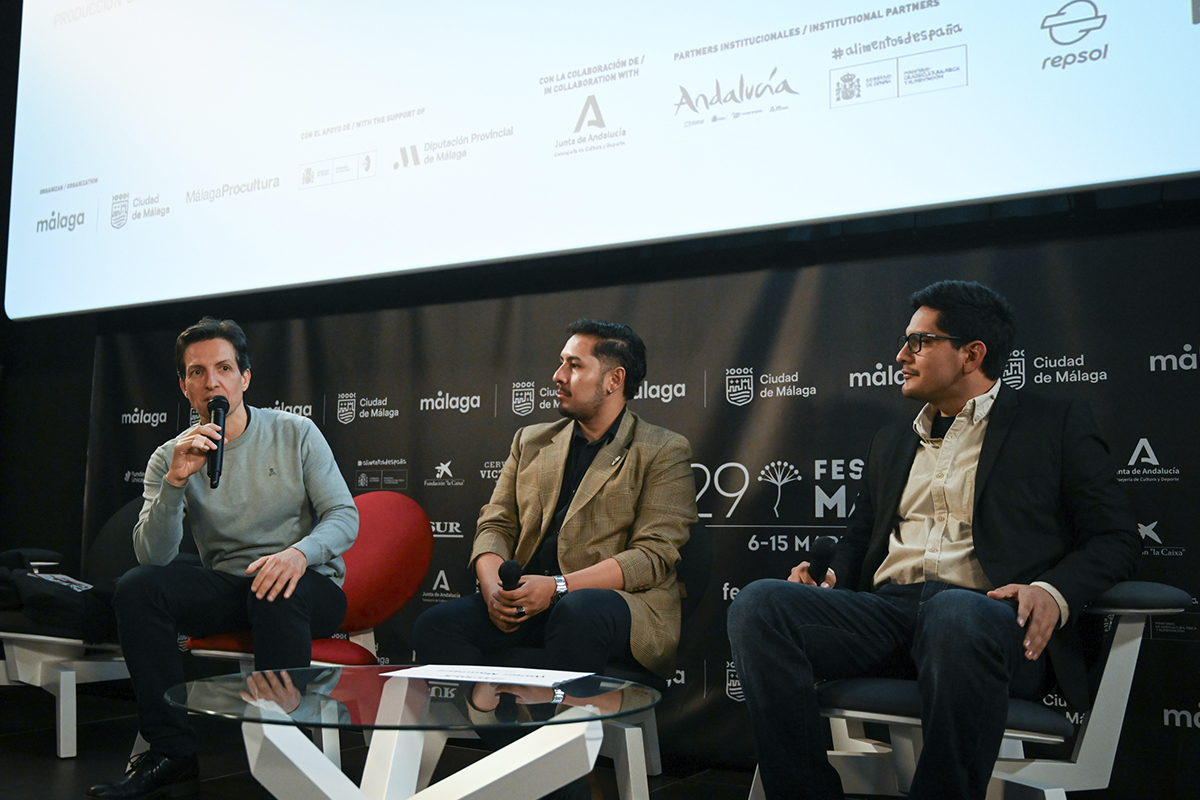
Following the screening of the film in Hall 3 of the Albéniz Cinema, a press conference was held with the participation of the director, Samuel Urbina, and the producer Walter Manrique, who shared with the media the origins of the film and the process of creating a story deeply linked to their territory.
"This is the European premiere of the film and we are very excited that it will be here in Malaga," said Urbina. The filmmaker explained that the work stems from a personal experience linked to migration: "It's a slow-paced film about silences and those awkward moments between a mother and child. It is a universal theme: moving from small towns to capital cities.
Originally from Piura, in northern Peru, Urbina experienced this process first-hand. "I had to migrate. I lived in Barcelona for two years, but we often forget those who stay behind, our parents, who are often already getting old. That's where the film comes from, trying to explore the perspective of the one who stays behind, in this case, the mother", she explained.
This approach is also transferred to the cinematographic language of the work. From the outset, the director was clear that the film should be constructed with fixed shots and a contemplative gaze: "From the moment I conceived the film I knew I wanted to work with fixed shots. I wanted to explore the territory, the heat, the desert. I wanted to explore that with the image.
Shot in the towns of Sechura, Piura and Sullana, all of them linked by the Piura desert, the film also incorporates cultural elements of the region, including music. "Piura is the capital of Peruvian cumbia, so we included the Piura Boys orchestra," Urbina explained. In this regard, producer Walter Manrique highlighted the significance of this choice: "Cumbia is very representative of Peru and usually talks about love or romantic disaffection. Here it is interesting how it is reframed to speak of a maternal-filial love".
The filmmaker cited among his influences contemporary Latin American cinema and authors such as Lisandro Alonso, and the work of Iranian directors such as Jafar Panahi and Abbas Kiarostami, references in his approach to cinematographic language.
During the meeting, Urbina and Manrique also reflected on the difficulties of making films outside Lima. The film began to take shape in 2019 and was made possible thanks to financial incentives from the Peruvian Ministry of Culture. "Making films outside Lima is very difficult. The production possibilities are very limited and so is the distribution," the director said: "The fact that the film has reached Malaga shows the richness of the stories we can tell outside the capital".
The producer also underlined the challenge of bringing this type of proposal to commercial cinemas. "We are looking for a commercial premiere in Peru. We would like to present it first at the Lima Film Festival and then try to get it into theatres. It's a huge battle, especially for a film like this".
Both have underlined the country's territorial diversity. "Many films focus on Lima or the Andes, but Peru is much more diverse," explained Manrique. "We want to break with this imaginary that reduces us to a single territory".
Along these lines, Urbina highlighted the film's value as a portrait of a region that is under represented in cinema. "Rarely has the Peruvian north been seen on screen. Piura is known for its beaches and some international productions have been shot there, but almost never in the city or in the desert," he said. Aquella sombra desvanecía thereby becomes the first film shot in Piura with DAFO funds to have its international premiere at a festival such as Malaga.
Samuel Urbina is a film director and producer born and based in Piura, Peru. He is interested in a cinema that moves between fiction and non-fiction, with territory as its starting point. His works have been presented at festivals such as Malaga, Guadalajara, São Paulo, Cartagena de Indias, Lima, among others.
Share