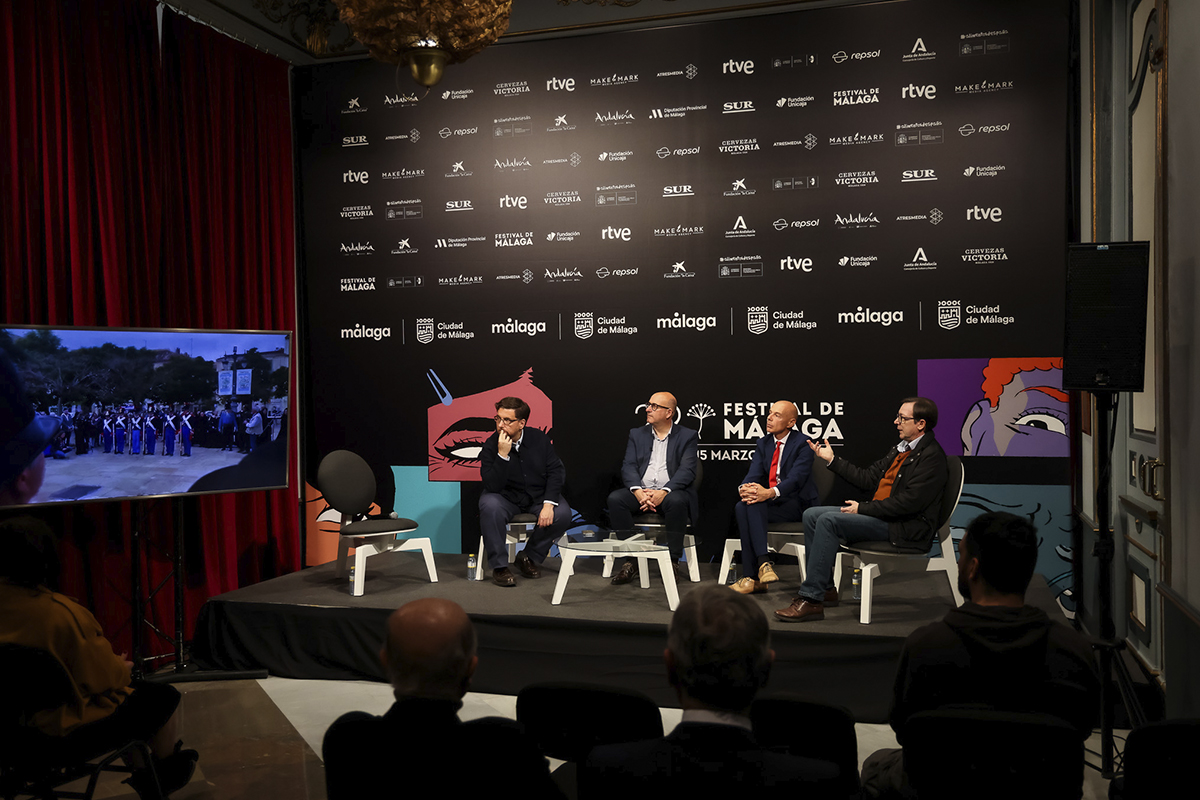
Torrijos: El último sueño liberal' (The Last Liberal Dream) celebrates the general's defence of liberty at the Festival de Málaga
Emilio Ruiz Barrachina's documentary reconstructs the military leader's final days and his connection to the province
On Thursday 12th, the Festival de Málaga hosted the official presentation of the documentary Torrijos: El último sueño liberal (The Last Liberal Dream) a production by Abengsa that revisits one of the most symbolic episodes of 19th-century Spanish liberalism.
The event was attended by Antonio Ismael Aragón, advisor to the Specific Area of Culture and Heritage; Manuel López Mestanza, Provincial Deputy for Culture and 5th Vice President; Juan Carlos Maldonado, Councillor and Second Deputy Mayor of Mijas; director Emilio Ruiz Barrachina; executive producer Francisco Quintero González; and representatives of organisations dedicated to promoting the historical memory of Torrijos.
The film begins with the landing of José María Torrijos and his 48 men on the coast of Málaga on 2 December, 1831, with the aim of ending the absolutism of Ferdinand VII and restoring constitutional order. The expected help from a supposed ally, who signed with the pseudonym "Viriato," never arrived. Defeated and captured, the liberals were executed days later on San Andrés beach, in an episode that would profoundly mark Spanish political memory.
The documentary combines dramatic re-enactments, historical documents, and expert testimonies to reconstruct those events and reflect on the ideal that drove Torrijos: the defence of a free, just, and constitutional Spain.
During the presentation, the president of the Torrijos 1831 Association, Esteban Alcántara, highlighted the importance of this project for organisations working to recover this historical memory. "I am very excited, because this project means a great deal to us. We’re an association that’s about to celebrate its 25th anniversary, and we wanted to establish a sisterhood in the three municipalities and to commemorate Torrijos. It’s a completely original project, and it’s the first time that all three municipalities have been included in this way,” he explained. Alcántara also emphasised the educational value of the work: “Torrijos died under a political system that is the same one we have today, a parliamentary monarchy. This documentary is going to be very informative.”
For his part, director Emilio Ruiz Barrachina pointed out that the documentary aims to bring this historical figure closer to the general public through the language of cinema. "Having a dramatised section that recreates the landing and the execution makes the documentary like a film. That will greatly help in understanding it,” he stated. The filmmaker also acknowledged that his own initial knowledge of Torrijos was limited: “As a child, my only connection to Torrijos was that my school was on Calle Torrijos in Madrid. The liberal period and Torrijos himself weren't studied, and I think that's a shortcoming. It's important that this figure be brought back into the public eye through educational materials.”
The project's executive producer, Francisco Quintero, described the work as “a necessary and essential documentary for understanding who Torrijos was in film and television format,” adding that he is a figure who remains alive in our memory and who, with this documentary, "is reborn".
In the institutional sphere, the Provincial Deputy for Culture, Manuel López Mestanza, highlighted the historical significance of the figure. "We talk about Torrijos as a fascinating character. What happened here put Mijas, Alhaurín, and Málaga on the map of Spain,” he noted, recalling that today he is interpreted as “a symbol of liberalism and democracy.”
Similarly, Juan Carlos Maldonado, the Councillor for Culture at Mijas Council, emphasised the importance of this figure for his municipality: “For Mijas, this is one of the most significant historical events we have. I believe we must give this figure the importance he truly deserves. It is essential to link this figure to our municipality.”
For his part, Antonio Ismael Aragón, advisor for the Culture and Historical Heritage department, recalled the tragic nature of the episode: “It is a tremendous drama, how some men practically allowed themselves to be deceived. It is a very interesting snapshot of the historical development of our country.”
With this new work, Emilio Ruiz Barrachina, a writer and filmmaker with extensive experience in historical and social commentary, brings back to life a figure who remains a symbol of the struggle for freedom in the history of Spain.
Share